I will always reply to comments and always re-reply to re-replies.

Clicking on most images will enlarge them

Friday, October 03, 2008

WONDERFUL CLOCK!

HerHimnBryn emailed this link to me. I enjoy clocks and watches (the mechanical kind) and this really floated my boat. I just had to share it with you all.

It is derived from John Harrison's wonderful clock of the 1700's (this is a long link, but the fascinating story it tells is well worth perseverence).

Thursday, October 02, 2008

BICYCLE GEARS - HISTORY LESSON


(apparently this "Penny-Farthing Band - German - is available for hire)


Barrett Bonden asked me about my cycle gearing in my previous posting and I said that my lowest gear was "23 inches". A non-cyclist would be justified in saying "pardon?" So I thought you might like to know the history behind this calculation.

In English speaking countries cycle gearing is usually measured in inches. You don't really need to know what these inches stand for, just that a large number makes you push harder to go faster whereas a small gear allows you to winch yourself slowly uphill.

Gear inches come from the days when geared bicycles superseded the ‘ordinary’ – now known as a penny-farthing. This had its pedals fixed directly to the front wheel and if you wanted to go faster you needed a larger one. So bicycles were rated by the diameter of this wheel. A 52inch ordinary bicycle was big and potentially fast for its time, but only a tall man could ride it.

Then the safety bicycle was invented, on which all modern bicycles are based and in which the pedals are connected to the rear wheel by a chain and gears. These make the wheel turn faster (or slower) according to the ratio of front chainwheel divided by rear sprocket. A gear ratio of 48 by 16 for example, makes the wheel turn three times for one turn of the pedals. The effect is the same as if the pedals were fixed directly to a wheel three times as big, making a 26 inch wheel equivalent to one of 78 inch diameter. Such a bicycle was said to be geared to 78 inches – that would be one heck of a tall penny-farthing!

This system may be antiquated, but referring all gearing arrangements (including hub gears) back to a simple size of directly driven wheel gives us an easy way to compare all sorts of pedal cycles.

To calculate gear size you enter the diameter (in inches - or metric people could enter it in cms) of the actual wheel, and the numbers of teeth on the front chainwheel and rear sprocket, into the following formula:
Gear = Wheel × Chainwheel ÷ Sprocket

Not a lot of people knew that! But now you do. My lowest gear (23 inches or 58 cm)would have me riding an old penny-farthing with a front wheel that size - it would be like a small child's bike!

Tuesday, September 30, 2008

FRIDAY RIDE

(click on any image to enlarge)
The forecast was "warm with a light breeze". It was a bright September morning. Autumn fruits were in abundance


Work had been frustrating during the week so I decided a day's leisurely cycling was called for.
As a warm-up I cycled to my morning coffee break (A garden centre in the hamlet of Reading Street). Good coffee (free refills), toasted teacake and blackcurrant jam. Then a gentle freewheel down the little lane that once led to a busy landing place on the River Rother. Mediaeval sailing ships once traded here and a series of ancient, prosperous houses line the lane. This one, dreaming behind its sere fencing, was once the harbour master's house:
However, in the 17th century a great storm diverted the river's main course; the harbour had to be abandoned and all that now remains of the river here is a country stream.
After this some low gear work was called for as I cycled up an escarpment onto what was once an island. A breather was called for
The curiously named locality (village long since disappeared) derives from the Saxon "Ebun's ie" (the island owned by Ebun) . You will note my stragically placed coffee flask, for later use.
A gentle climb brings us to the summit of the "island" and the village of Wittersham

The Viking ship on the village sign reminds us that all this area was subjected to Danish raiding parties in the 9th/10th centuries.
Here I stopped to consult my map. I could see an interesting route would follow a road, then a farm track and then a bridle path going South towards Rye. The track went through the grounds of a stately home and the bridle path crossed a small river, but, what the hell, let's give it a go. So, inspired by the button badge on my saddlebag (a present from Herhimnbryn), I set off.
The road was swallowed by the gates of the statelyhome, with a notice saying "private drive". A cycle is an ideal way of traversing such a road - silence and celerity! We whisked through without disturbing His Lordship and out onto the farm track the other side. I was encouraged by the sign on the farm gate - the man must have a sense of humour

A couple of miles of rocky farm track followed and then the road petered out descending like a rabbit hole into a single pathway through the trees. This was mountain bike country, but I was tackling much worse than this on normal road lightweight bikes before they were even thought of (we called it "roughstuffing" and didn't know that you needed a special bike for it).
Eventually I broke through the trees and descended into the wide valley of the little River Tillingham, pushed the bike over a little footbridge and toiled up the other side of the valley.
(Down the hill by the finger of trees and over the footbridge by the pylon)
Let's have a look back over the vast valley - how could such a tiny river have carved it out? The answer lies some 10,000 years ago when the glaciers of our last ice age melted and mighty torrents of water roared down from the hinterland rolling rocks and debris before them.

At last, back on a firm road, I made my way through Rye's mediaeval gate into the ancient town.
It was time to take on fuel - elevenses having long been burnt up. Heavy meals don't suit me when cycling (a full stomach gets in the way when bending over dropped handlebars). So a couple of fried eggs ("easy over" for you American readers) with two slices of toast made from locally baked brown bread - plus a large pot of tea - topped me up nicely.
I crossed over the River Rother Bridge out of Rye (the following picture shows why these places are no longer ports - in a word "mud" - silt brought down in quantities for the Wealden clays)

I was now on the levels of Romney Marsh and decided to follow the cycle track which paralleled the road for some 9 miles towards the town of Lydd. At the outset of this screed I mentioned that the forecast was for "light breezes" - Hell! it was like cycling into a solid wall of air, with head wind at about 25 mph. (whilst The Marsh is pleasant cycling on calm days - no hills , it can be savagely windswept at times). This pleasant path-side scene belies the air whistling by my head at the time.

And so at last to Lydd - it's name sounds Welsh (but is Saxon). In fact it could hardly be farther from Wales, being the most southeastern town in Britain. I say town, but really a large village.

D'you see the whitewashed shop by the church? Well I decided I deserved a treat. I sat behind a church buttress, warm to my back, in the sun and out of the wind and indulged!
After that, the push for home - however there was another stop on the way - a church I had not visited before (I feel that Larkin's poem "Church Going" sort of sums my travels up beautifully)
Once I am sure there’s nothing going on
I step inside, letting the door thud shut.
Another church: matting, seats and stone,
And little books; sprawlings of flowers, cut
For Sunday, brownish now: some brass and stuff
Up at the holy end; the small neat organ;
And a tense, musty, unignorable silence,
Brewed God knows how long. Hatless, I take off
My cycle clips in awkward reverence…………..
This is the church of St Mary the Virgin in the aptly named Marsh village of St Mary-in-the-Marsh
I'm glad I went in - for those of us who have a "handkerchief moment" at the "Daddy, my Daddy" scene in the film "The Railway Children" it will have special significance - the author Edith M Nesbit lived happily in the village with her second husband, "The Skipper" and is buried here. She required that no stone be erected on her grave so her husband carved a wooden marker over it - it is under the oak tree to the right of the churchyard.
Looking at the map, the direct route home would have brought me up to about 45 miles. "Why not make it the round 50?", I thought. So I braved the wind and put in a loop which had me finishing my flask of coffee, sitting in the late afternoon sun at my favourite stopping place.
And the final mileage? - 51.6 (82 km for those of you with a less "Imperial" bent!) and in spite of the wind a very pleasant day (would you believe that the following day there was not a breath of air - sod's law!)

Sunday, September 21, 2008

A DAY OUT

A balmy Autumn day meandering among the hedgerowed lanes of the Kentish Weald with members of the Veteran-Cycle Club - about a 25 mile circle with the village of Headcorn at its centre. 18 out - riding up and down the column chatting to various about various. Lunch at a 16th century country inn. Cakes and coffee at the end, watching vintage aircraft doing stunts at a country airfield. "Jus perfick" (as a local character would have it).

We stopped on the way for a group photo - the road name seemed appropriate!

(click to enlarge)


Thursday, September 11, 2008

Introducing Benjy


There was an unusual guest on the recent Veteran-Cycle Club run (a gentle day cruising the lanes of Romney Marsh, with lunch in the ancient town of Rye - 25 leisurely miles, riding the recently acquired Rudge.)

His name is Benjy and apparently he rides everywhere with his mistress. Needless to say he was a very popular addition to the group (about 25). He was quite happy on the back and settled down for a snooze whilst we all had lunch.
And John Head's beloved old Rudge ? - it cruised as serenely and majestically as a bishop walking up the aisle of a cathedral.

Thursday, September 04, 2008

APOLOGIES FOR ABSENCE


Have not blogged recently (although I have accessed many of yours).
Reason? My PC crashed catastrophically and since I was on Windows 2000 and the PC was as old as that I decided the time was ripe to get a new one.
So arrived home with a large box and multi-layer packing, from which I delved the new, matt black PC - there is no joy in any of this - it is just as much a tool to me as a bicycle pump.
So I now have the joy(?) of Vista (am I a masochist?). My scanner would not work on it, HP did not have a new driver and more or less told me to get a new scanner (or get stuffed) - so I did, but you bet it was not a Hewlitt Packard. My Canon printer worked with a readily available new driver, so it was a Canon scanner I bought.
Most of my programs seemed to load OK - I have even managed to get Office 97 Professional to work in Vista (which the PC shop said was impossible and "could they sell me the latest Office Suite".)
So.......having been staring, with frustration at a screen and frantic (and expensive) telephone calls to help lines , I have been heartily sick of PCs and the internet.
I did ask myself if I could manage without a PC, but decided not (although I managed to get through life for the previous 50 or so years without).
So..........that is the reason for absence - my sense of humour is gradually returning.
Monday, July 28, 2008

TOMBSTONE

During a gentle cycling day with the Veteran-Cycle Club (which will be posted up later), we chanced to stop at the 13th century church at Brookland. I just had to share with you this gravestone in the floor of the nave.


What a magnificent name - they don't write 'em like that any more! I see that his wife, Ann, only outlasted him by a month (who says you cannot die of a broken heart?)

Friday, June 20, 2008

COMMERCIAL BREAK

That "HerhimnBryn" at Secret Hill Mosaics says she is going through a creative block at present.

Mosaics are not currently inspiring her, so it would appear that she decided to set up another sort of blog to keep that creative mind of hers from rusting. Even at the age of two she was intent on creating a "stone and water feature", by blocking our back-yard drainpipe with pebbles! (sorry H!)

I just mention this in case others would like to follow me there (and also because I feel a certain parental duty - and pride!)

Thursday, June 19, 2008

LEONARD COHEN


To all lovers of the sublime Leonard:

Can I recommend a visit to the blog of "riseoutofme" see also this link for background.

Saturday, June 14, 2008

MARMITE RICE CAKES


I don't know how long these have been around, Marmite Lovers, but I have just found them and they are absolutely delicious - particularly with a dab of creamy Irish Butter.
We have started buying Irish butter as from today in thanks for that great country saying "No" in their referendum to the scandalous proposed EU Constitution. This country is not being allowed a referendum on the subject in spite of this government's promise in their election manifesto to hold one. I will be toasting the Irish in Guinness today!
(Interestingly, the Irish language does not contain a word for "No" - instead it uses the phrase "it isn't")

Saturday, May 31, 2008

THE GYPSY LIFE


It's time to put the old horse between the shafts (figuratively speaking) and trot off with the caravan again. (Although I guess that a real horse might be a lot more economical than a car with the way fuel prices are going).

A couple of weeks way down West are planned. First to our beloved and nostalgic Cornwall. We return to a little farm site just south of Launceston most years. It is centrally located for the coast and the moors.

Then stopping over for a week in Dorset on the way back (near Cerne Abbas, with its ancient, priapic hill figure).

The weather forecast is not too good (my neighbour says he always knows when wet weather is going to set in - it is when we go on holiday!) Still - we take it as it comes.

Catch y'all later.

Wednesday, May 21, 2008

RUDGE "SUPERBE"


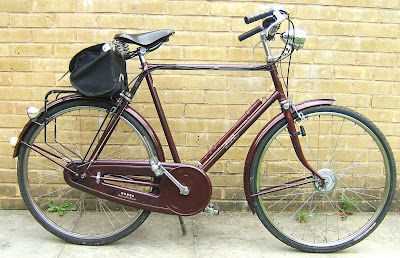
In 1961 John Head wanted a bicycle to cycle across London to his job at the Bank of England. In view of the prestige of his employment he decided that it must be a "gentlemanly" machine in keeping with his dignity. Accordingly, he did his research and decided that the "Rudge Superbe" fitted the bill. Rudge cycles were by now part of the Raleigh cycle empire. He bought the deep red bicycle from a little south west London cycle agent:
Over the years the cycle carried him to and from work. He had children, joined the Cyclists' Touring Club and, eventually the Veteran-Cycle Club (having acquired a variety of machines over the years). But the Rudge was always his favourite bicycle and even though it was a "gentlemanly machine" he used it at cycle camps and rallies.

We now fast-forward to 2008. John is now 82. He always vowed to keep on riding his Rudge, but has reached the stage where he can no longer lift his leg over the cross-bar. To keep on riding (he has my respect) he bought a modern, open-framed bike. The Rudge was oiled up and stored, but he felt it a shame that it was no longer used and (reluctantly) advertised it for sale in the Veteran-Cycle Club's magazine for £100 (a satisfactory mark-up as it cost £28 in 1961).

This is where I come in. I saw the advert, then forgot it. 3 weeks later I re-read it, thought I would give him a ring, although I guessed it would have been sold. But no, he "had been mucked about" and it was still there. So I made the trip to West London and spent a morning with John and his wife (his reminiscenses were worth £50 alone!) and paid the full price for his beautiful, original and much loved machine. Here he proudly displays it on the day of sale:

Having taken it home and introduced it to my own bicycles, you see it here in detail

The saddle is a magnificently comfortable Brooks "B66" with large insulating springs

The chaincase protects the drive and means that one can ride it without resorting to trouser clips, or tucking them in your socks to avoid oil stains

Lighting is provided by the still working Sturmey-Archer hub dynamo set in stainless steel wheel rims and the magnificently chromed head lamp. Gearing (very low) is by Sturmey-Archer 3 speed in the rear hub.

The bell gives out a sonorous "ding-dong", befitting the bicycle's dignity, whilst the stand enables it to stand alone (nothing so common as leaning it against a wall!)

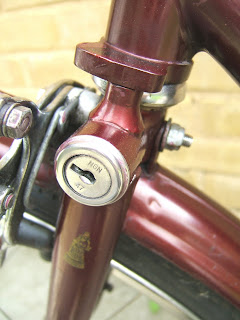
Fortunately your average bicycle thief would not give the bike a second glance (they only seem to pinch mountain bikes) - however the Rudge comes with a built in fork lock (John even supplied the two original keys)
The Rudge is a nice ride. Unlike my "head down, arse up" drop handlebarred bikes, it will not be hurried. As befits a "gentleman's bicycle" one sits high in the saddle, looking over the scenery whilst cruising serenely along. On the flat it will allow itself to run at about 12 mph. Middle gear takes care of head winds and slight rises, whilst I am astounded how the low bottom gear allows one to ride up almost any hill. One almost feels that a collar and tie should be worn when riding it!
I use it frequently to do the 3 miles into town and it will get its first run out (under my ownership) with the Veteran-Cycle Club in July. Appropriately it will be a local ride - "A Marsh Meander" over Romney Marsh, ending up for fish and chips at a cafe in the ancient town of Rye.

Tuesday, April 29, 2008

BLUEBELLS (for HHnB)


HHnB writes about her childhood memories of Bluebells, so I thought that I would give her a treat and publish a few photos just taken in the wood over the way from here.

Anne Bronte's poem on the subject seems particularly apposite:

"There is a silent eloquence
In every wild bluebell
That fills my softened heart with bliss
That words could never tell "


and is worth reading in full, H


Anne Bronte's sister Emily, also wrote a poem on the same subject, but I prefer Anne's.

Of course, the dog, Sabre, had to get in on the photoshoot. Some children had left a rope swing which he decided was worth playing with. He is 11 (77 in human years) but still thinks he can act like a kid (a bit like the bloke he lives with, I suppose!)


Thursday, April 17, 2008

COFFEE, CAKE AND THINGS

(click on any image to enlarge)
A couple of streets away lives a feisty 87 year old lady, a widow who is fiercely independent but has come to know me, through my wife. She has had a interesting life - who would think to see this upright, beautifully dressed, silver haired woman that she was a Sergeant in the Woman's Royal Army Corps in World War II and commanded men manning an anti-aircraft battery which shot down a number of German bombers. On Remembrance Day each year she proudly wears her military beret with badge and her medals on her chest. (Aspects of  this poem come to mind).

She sometimes asks me to do the odd "handyman job" which she cannot manage (she is proud of the large box of her late husband's tools - she always tells me she has the tools for the job!). She is an excellent cook and I usually get a "quid pro quo" in the form of cake. Her new fridge has arrived - the door was on the wrong side, so she asked if I could change it - job done.


. Two days later my wife arrived home with a plastic box containing half a delicious jam sponge from her. I felt that the gift needed proper appreciation - the day was warm and springlike and a cycle ride beckoned. Cake and a flask of coffee were packed and off I pedalled to spend a leisurely couple of hours adrift amongst the lanes - the target being one of my favourite stops - St Rumwold's Church


A convenient seat in the sun presents itself and I settle down to do the jam sponge justice.


(To enhance the meal the coffee was how I like it - laced with brandy!)


Sitting and musing in the sun I was kept company by my (very) old companion here - James Jordan, who sleeps beside my seat.


Let's have a look at his stone - it is written in archaic manner with the internal   " s " written like an " f ". To save you enlarging the image it reads:

"Here lieth James Jordan
late of this Parifh, Yeoman
He died May ye 9th 1745
Aged 68 Years.
And alfo Seven Children
Four by Mary his firft Wife
One by Ann his second
And two by Elizabeth his Third"

A busy man who deserves his long, long rest!


But - where are my manners! I have brought you all the way down here and forced you to look on whilst I indulged - yet I have not shown you around the church. Let's go to the main door. Its woodwork was cut from Kentish oak trees 700 years ago


Regular readers of my blog will remember my love and affinity with wrought iron so it is a delight to put one's hand into the door's latch-ring


And so we enter this, probably the oldest church on Romney Marsh, dating back to Saxon times (c.800 AD). A tiny, scintillating gem of a building whether you have a religion or no.


You will notice the proliferation of candles - these are very necessary since the church has no electricity. This is a real delight at the yearly Christmas carol service with the holly and ivy glinting with the brasswork in the winking candlelight - the music being provided by a string ensemble in the ancient gallery at the back, as in times past.

Thanks for joining my serendipity - just look where opening a fridge door has led us! (shades of Narnia!)

Thursday, March 27, 2008

SECRET HILL (HHnB)

Those who have not been to "Secret Hill" recently will not know that she has done a bunk and set herself up with a new blog address.
If you want to catch up with her go to:
www.secrethillmosaics.blogspot.com/
(Commission please, Duchess!)

Friday, March 21, 2008

ROMAN SHIELDS AGAIN!

(Click on any image to enlarge)

This time last year I was involved in making a pair of Roman Cavalry Shields . Trouble is, I did too good a job of it and the Society has asked me to paint 6 Auxiliary Infantry Shields for use this year. The design is copied from one shown on Trajan's Column.
A pleasant enough job, painting in a warm dining room (I have an understanding wife) whilst the wind and rain beat against the windows. Now I have finished my part and the shields move on to have the bronze edging (to guard against sword cuts) and the centre bosses fitted.

Here is a finished one in close up. The unit represented is named in the "ansate" at the top (The small rectangular blue label with "ears" which is a feature of Roman inscriptions). It is the First Cohort of Tungrians , troops drawn from what is now modern Belgium - they were once stationed on Hadrian's Wall in the first century AD. The laurel leaves have obvious meaning. The two crescent moons relate to the veneration of Cybele, the Magna Mater or Great Mother.

All done for love and interest, unfortunately. Checking armour makers on the internet shows that such as these go for at least £150 each!

This link will explain how the Auxilia fits into the Roman Army - if you have time to wade through it. But briefly they were locals recruited from outside of Italy, not Roman citizens. (A bit like the native troops recruited by the British Empire). They never served in their own countries, for obvious reasons and were only paid a third of Legionary pay. The bonus was that they were awarded Roman citizenship after their 25 years service - a big deal in those times.

Here is a painting by Society member Graham Sumner of an Auxiliary (Society member Adrian Cook) , using a shield of similar pattern but different colouring.